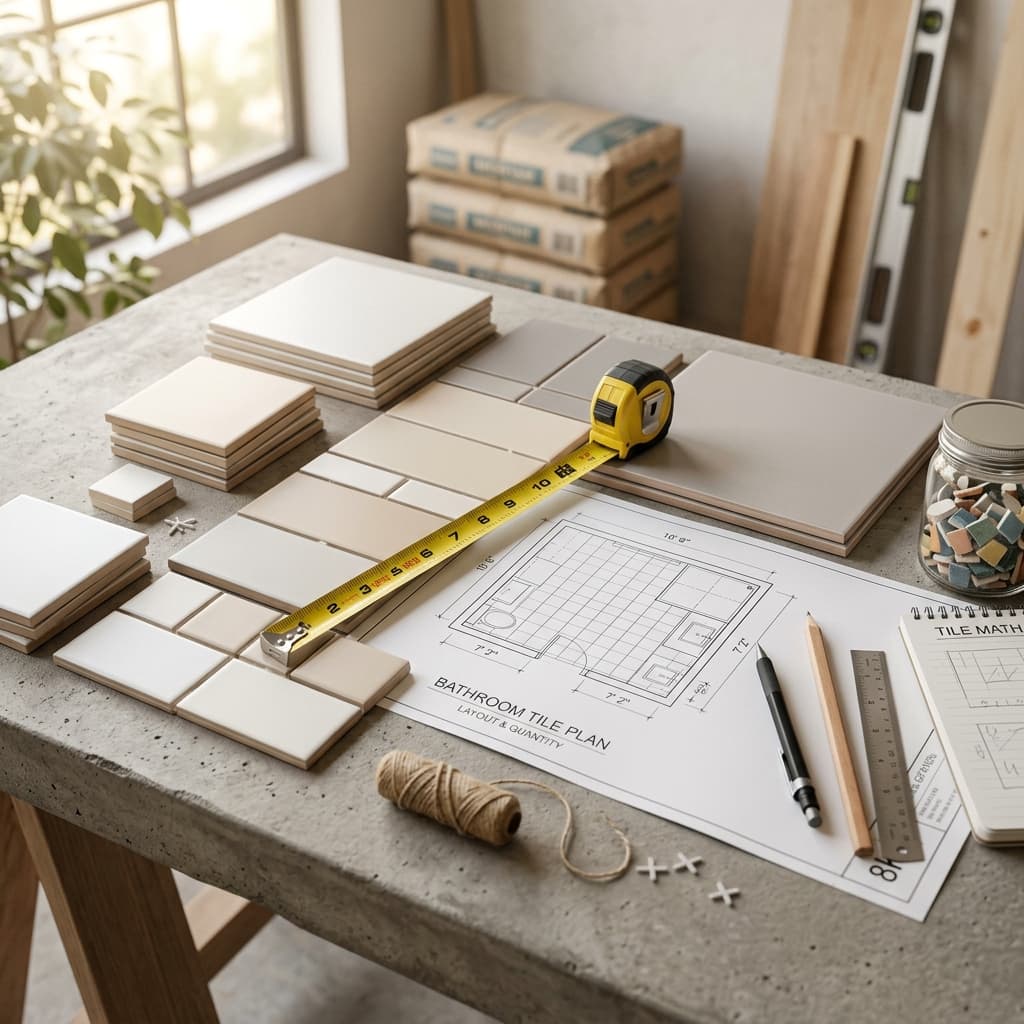
How to Calculate Tiles for Floors and Walls: A Step-by-Step Guide
Complete guide to tile calculation for floors and walls. Learn module area calculation, spacing, layouts, and estimating grout and tile adhesive.
How to Calculate Tiles Without Overpaying or Running Short
Buying tiles is one of the most expensive parts of a bathroom or kitchen renovation. It is easy to make a mistake: buy too little, and you might find that the tiles from a new batch differ slightly in shade or caliber. Buy too much, and you will end up with leftover boxes that the store might not take back because the return window has closed.
To make an accurate calculation, you need to consider not only the net area of the walls or floors but also the grout width, layout method, corner cuts, and the presence of doors, windows, and fixed furniture.
Below, we explain the professional calculation methodology, formulas, and examples step-by-step.
1. The Golden Rule: The Tile Module Area
A common beginner's mistake is dividing the total room area by the nominal area of a single tile. For example, if a room is 6 m² and the tiles are 30×30 cm (0.09 m²), it seems you need exactly 6 / 0.09 = 66.6, which rounds to 67 tiles.
In reality, tiles are never laid edge-to-edge; there is always a grout joint (usually between 1.5 and 5 mm) between them. Therefore, professional calculation is based on the tile module.
Note. A tile module is the virtual size of a tile, increased by the width of the grout joint on two sides.
The formula for the area of a single module:
Module Area (m²) = ((Tile Length (cm) + Grout Joint (cm)) / 100) × ((Tile Width (cm) + Grout Joint (cm)) / 100)
For example, for a 30×30 cm tile with a 2 mm (0.2 cm) grout joint:
- Module Length: 30 + 0.2 = 30.2 cm = 0.302 m
- Module Area: 0.302 × 0.302 = 0.0912 m²
This difference may seem tiny, but over a 20 m² area, accounting for the grout width can save you several whole tiles!
2. Calculating Floor Tiles
When calculating floor tiles, use the following steps:
- Calculate the total floor area: Length × Width.
- Subtract the area of zones where tiles will not be laid (e.g., underneath a built-in bathtub or screen).
- Divide the net floor area by the area of a single tile module.
- Add a waste percentage based on the selected layout.
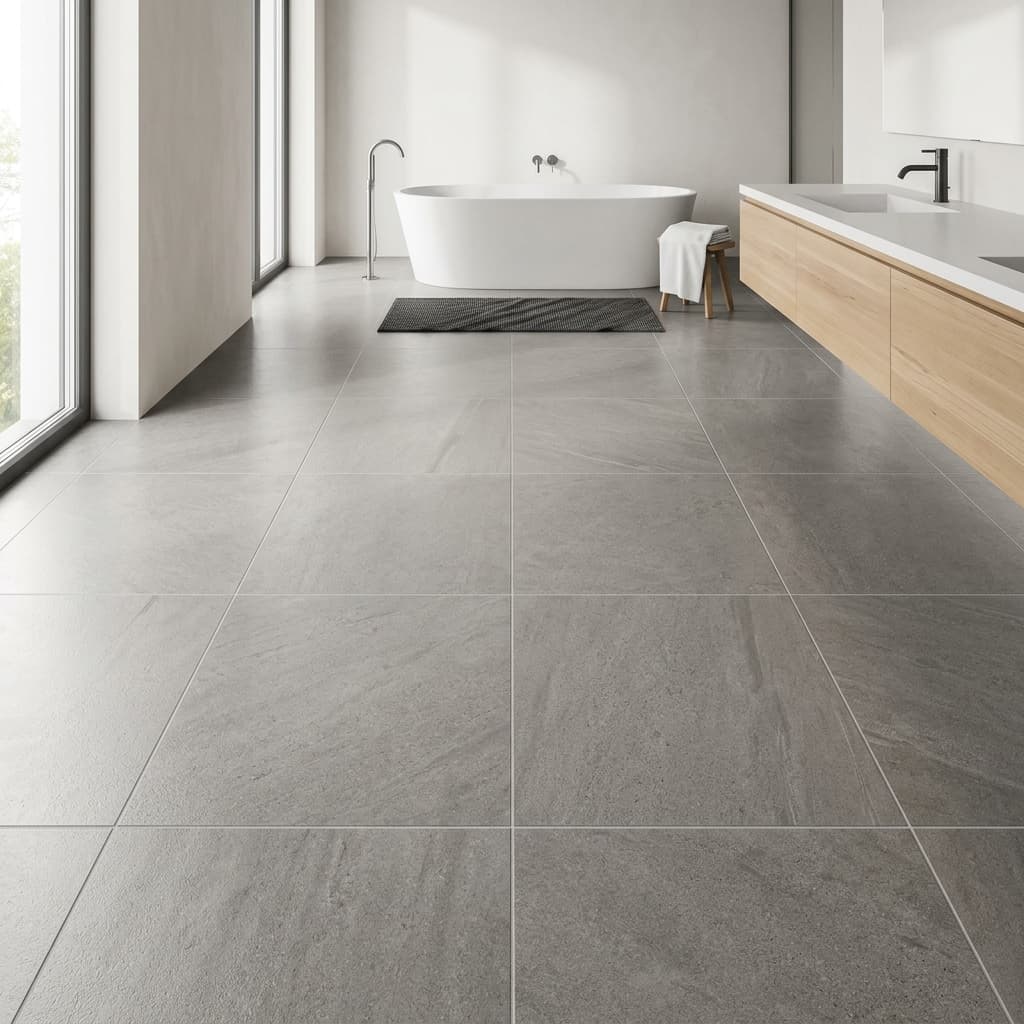
Calculation Example:
- Floor length: 3.0 m
- Floor width: 2.5 m
- Built-in bathtub (subtracted zone): 1.2 m²
- Tile size: 60×60 cm (0.6 × 0.6 m)
- Grout joint: 2 mm (0.002 m)
- Layout: Straight (base waste 10%)
Then:
- Net Floor Area: (3.0 × 2.5) − 1.2 = 6.3 m²
- Module Area: (0.6 + 0.002) × (0.6 + 0.002) = 0.602 × 0.602 = 0.3624 m²
- Tiles Needed without Waste: 6.3 / 0.3624 = 17.38 pcs
Adding the 10% base waste for a straight layout:
- Total Tiles: 17.38 × 1.10 = 19.12 → round up to 20 pcs
3. Calculating Wall Tiles
Wall tile calculation is slightly more complex because walls are interrupted by doorways, windows, or plumbing boxes.
Wall Calculation Steps:
- Calculate the perimeter of the room (sum of all wall lengths).
- Multiply the perimeter by the tiling height to get the gross wall area.
- Subtract the area of doors and windows.
- Divide this net area by the tile module area.
- Add the waste percentage.
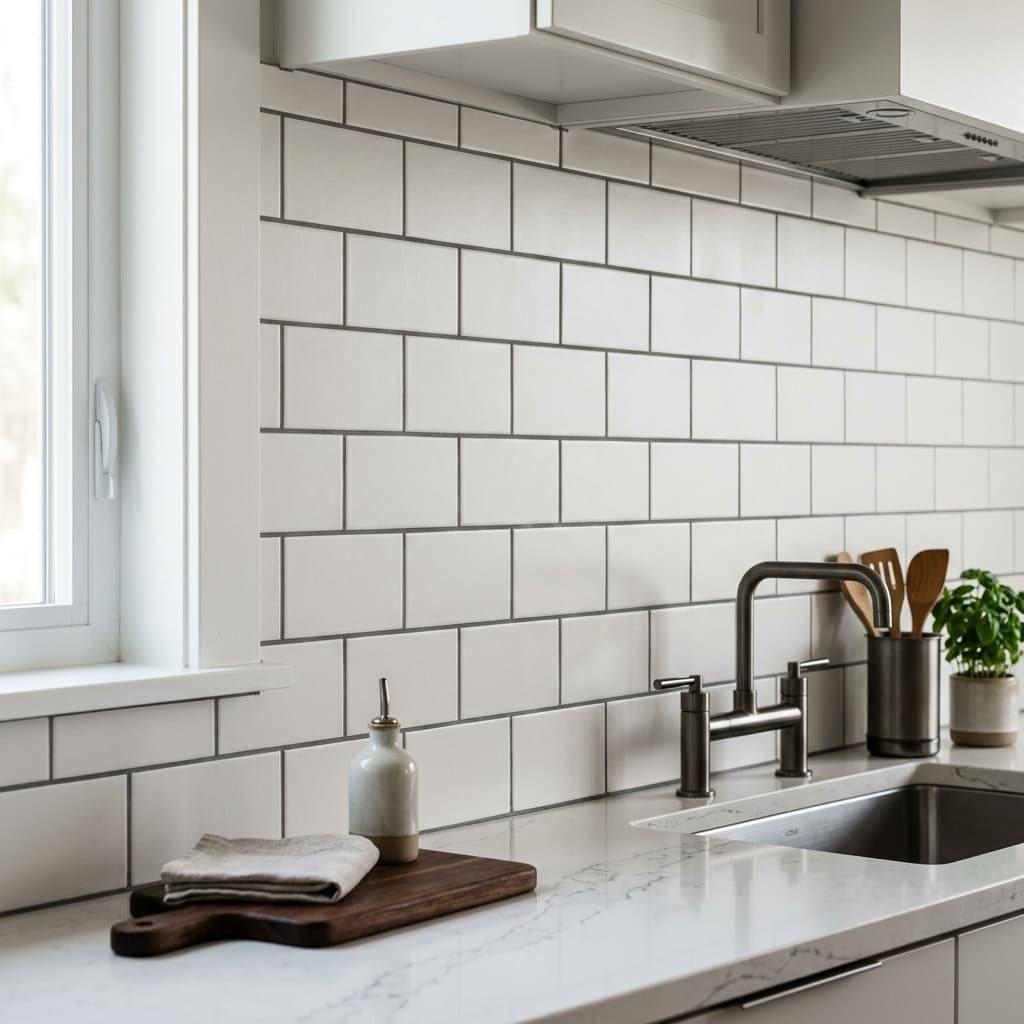
Caution when subtracting openings! If a door or window is located close to a corner or has an irregular shape, cutting tiles around it will generate extra waste. If you subtract the opening area completely without compensating for this, you may run short. For safety, add an extra 3–5% to the final waste percentage if the walls have multiple openings.
4. How Layout Affects Cutting Waste
The tiling layout directly influences the amount of cutting waste. The more complex the pattern, the more offcuts you will discard.
| Tiling Layout | Base Waste Percentage | Notes |
|---|---|---|
| Straight (seam to seam) | 10% | The most economical option. Offcuts from one end of a row can often be used to start the next. |
| Brick Pattern (offset) | 12% | Requires neat offsets. Produces slightly more waste at the wall edges. |
| Diagonal | 15% | All tiles meeting the corners and walls are cut at a 45-degree angle. High waste rate. |
| Herringbone | 20% | Used for narrow rectangular wood-look tiles. Highly complex, producing significant corner waste. |
If your room has a complex layout (e.g., multiple external corners, niche cutouts, pipe boxes), add an extra 5% (additional waste) to the base percentage.
5. Estimating Tile Adhesive and Grout
For a high-quality tile installation, you also need to accurately estimate helper materials.
Tile Adhesive Estimate
The consumption of dry tile adhesive depends on the tile size and the trowel notch size. For most residential projects, the industry average is:
Adhesive Consumption = 4.5 kg per 1 m² of net area
For our 6.3 m² area, you will need:
- 6.3 × 4.5 = 28.35 kg → need two 25 kg bags (with reserve)
Grout Calculation Formula
Grout needs depend on tile dimensions and depth. Here is the standard formula to calculate grout consumption in kilograms per square meter:
Grout Consumption (kg/m²) = ((A + B) / (A × B)) × C × D × 1.6
Where:
- A — Tile length (mm);
- B — Tile width (mm);
- C — Tile thickness (mm);
- D — Grout joint width (mm);
- 1.6 — Density coefficient of the grout mix.
Example for a 300×300 mm tile, 8 mm thick with a 2 mm joint:
Consumption = ((300 + 300) / (300 × 300)) × 8 × 2 × 1.6 = (600 / 90000) × 16 × 1.6 ≈ 0.17 kg/m²
Try the Tile Calculator Online
Use our interactive Renohacks Pro Tool to compute your tiling needs instantly. It calculates the exact tile piece count, package quantity, net surface area, and required tile adhesive.
Tile Calculator
Calculate the exact number of tiles needed for floors or walls, including waste, grout, and adhesive.
Measure from wall to wall
From one wall to another
If there is a built-in bathtub or fixed screen
Indicated on the package, e.g. 30×30 cm
For square tiles, same as length
For grout calculation
Usually 1.5–3 mm
For pack count
If work experience is low, add 5–10%
❓ Frequently Asked Questions (FAQ)
Should I round up the tile box count?
Yes, stores sell tiles in whole boxes (except for decorative borders or mosaics which can be bought individually). Always round up the calculated box count.
What if some tiles arrive broken?
A typical transit breakage allowance is up to 2-3% of the total order. This is why a layout waste allowance is added. Check all boxes for cracked pieces when they are delivered to your site.
How do I calculate grout if I use different tile sizes?
In this case, compute the area for each tile type separately using the grout formula for their respective sizes, and then sum up the results.
What grout joint size is recommended for porcelain tile?
For rectified (sharp edge) porcelain tiles, a joint of 1.5–2 mm is common. For regular molded edges, a joint of 2.5–3 mm is recommended to hide any minor sizing tolerances.
Summary
Accurate tile calculation depends on three simple rules:
- Base calculations on the tile module (tile + joint) rather than just the nominal tile dimensions.
- Factor in the correct waste percentage based on your layout style (from 10% up to 20%).
- Always round up package counts and adhesive bags to the next whole number.
Using a calculator and following standard formulas will prevent project delays and save you from overpaying for unnecessary building supplies.
Calculate tile and waste first
Start with the main calculator, then use the two tools that most naturally follow this article.
This piece is built around dimensions, material waste, and practical calculations needed before ordering.