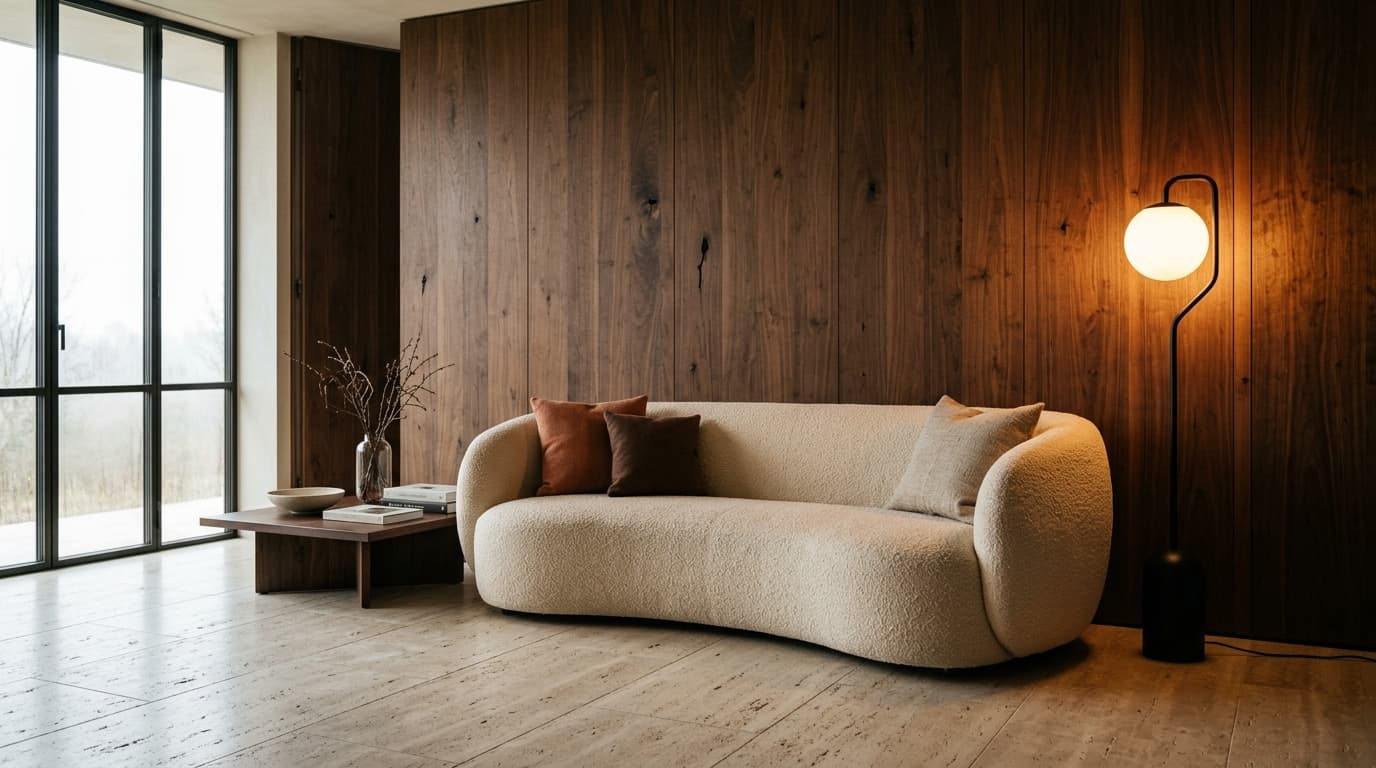
Interior Design & Renovation Trends 2027: Rebellion Against Sterility, New Colors & Real Budgets
Interior design and renovation trends for 2027: the pushback against sterile spaces, 5 color palettes with exact HEX codes, tactile materials, invisible smart homes, and honest room-by-room budgets. Backed by Sherwin-Williams, Homes & Gardens, Forbes, and NKBA.
Interior Design & Renovation Trends 2027: Rebellion Against Sterility, New Colors & Real Budgets
If 2025 was the year of identical Pinterest interiors and 2026 was the era of AI-generated design, then 2027 is the year of the pushback. The internet is saturated with flawless, dust-free spaces. Everything started looking the same.
Sherwin-Williams stated it plainly in their Colormix 2027 "Rewild" forecast: "With the oversaturation of digital perfection, it's becoming harder to tell what's real from what's generated." Leading design authority Homes & Gardens confirms: the defining quality of the best interiors in 2027 is "considered authenticity" — the deliberate opposite of the algorithmically polished image.
2027 is the year of humanity returning to the home. Imperfection. History. Patina. Intentionality.
1. The Color Revolution: Brown Is the New Gray
After a decade of cool gray, the market has pivoted to warmth. Cold neutrals are retreating and earthy tones are taking their place. According to Bocado Lobo and NordicNest, deep saturated tones — chocolate, burgundy, dark cherry, and forest green — are becoming the new neutral base, not the accent.
Sherwin-Williams made history by releasing not a single Color of the Year but a full palette of 48 shades called "Rewild" — a direct response to trend fatigue. Their anchor color for 2027 is Celery (SW 6421), a soft herbal green-yellow described as an intentionally "non-algorithmic" choice. Other major brands are moving in the same direction: Dulux named Soulful Sage, Behr chose Grounded (a mossy olive), and trend forecasters WGSN in collaboration with Coloro selected Luminous Blue — a rich cobalt-adjacent lapis — as the defining accent color of the year.
Five Palettes That Will Define 2027
Earth & Clay — terracotta, ochre, sandstone. Ideal for living rooms and kitchens, pairs with linen and oak. Key tones: #D4A574 · #C89F5C · #8B7355
Cocoa Bar — chocolate, espresso, tobacco, mushroom. Perfect for dining rooms, studies, and fireplace zones. Warm 2700K lighting is essential. Key tones: #4B3621 · #5D4037 · #6D4C41
Butter & Sage — soft yellow and muted green. Kitchens, children's rooms, breakfast nooks. Key tones: #F5DEB3 · #D4E4C7 · #98A689
Ink & Stone — deep indigo and slate gray. Bedrooms, studies, home offices. Key tones: #1A237E · #455A64 · #37474F
Oxblood & Cream — rich burgundy and soft cream. Traditional living rooms, libraries. Key tones: #800020 · #5D1918 · #FFFDD0
Color Drenching: How to Do It Right
One hue across every surface — walls, baseboards, ceiling, sometimes even upholstery. The result is a deeply cocooning, enveloping room.
How to apply it without mistakes:
- choose a mid-depth tone, not too pale (light tones lose the effect)
- vary only the sheen level: flat/matte on walls, eggshell on doors and trim
- works best in smaller enclosed rooms: entryways, walk-in closets, home offices
Tip: Don't drench your entire home in one color — you'll tire of it. Pick one room and commit fully.
2. Materials: Tactility and Patina
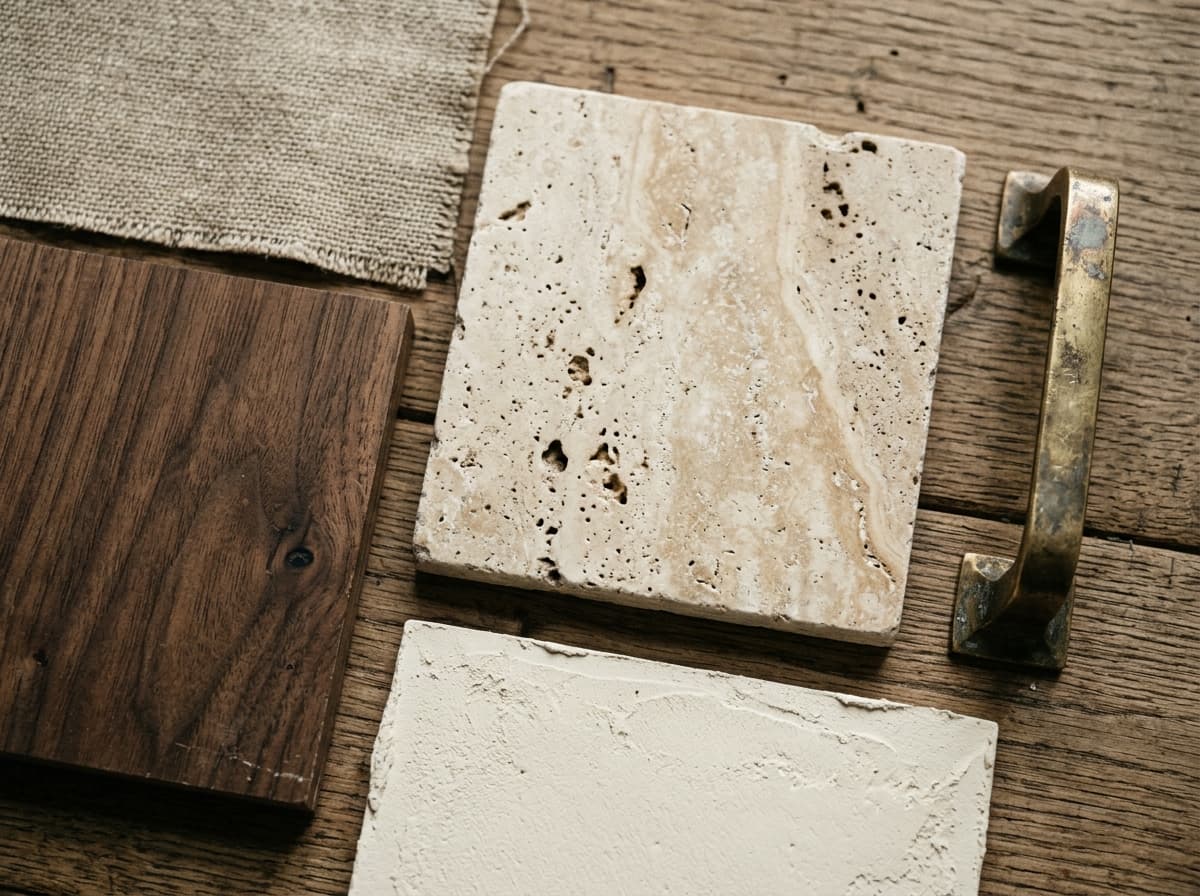
The defining material principle of 2027: choose what ages beautifully. Not what looks perfect when you buy it — what becomes better over ten years. As Melaura notes, "sustainability has stopped being an aesthetic category — it is now a baseline expectation." Cavmir observes that designers have openly "broken up" with ubiquitous bouclé and synthetic imitations: mohair, alpaca, coarse linen, tweed, and embroidery are taking over.
What's In
- Limewash and lime plaster — breathable, antibacterial, with organic variegation. A finish that improves with age
- Travertine — sedimentary stone with natural pores and veining. The point is not to polish it to a gloss — the imperfections are the aesthetic
- Unlacquered brass — it ages, darkens, develops a patina. That is exactly what designers now want
- Reclaimed timber — old wood with history; reduces deforestation and adds irreplaceable warmth
- Dark walnut — rich grain, deep tone, quiet status without ostentation
- Mycelium and hempcrete — bio-materials grown from fungal networks and hemp are moving from niche to accessible
| Material | Why It's Chosen | Where It's Used |
|---|---|---|
| Travertine | Ages beautifully, warm tactile feel | Floors, walls, countertops |
| Reclaimed timber | History, warmth, low carbon footprint | Floors, custom furniture, accents |
| Lime plaster | Breathable, antimicrobial, low-VOC | Walls, ceilings, range hoods |
| Unlacquered brass | Develops living patina over time | Sconces, faucets, cabinet hardware |
| Linen & wool | Tactile, organic, natural drape | Upholstery, drapery, soft goods |
| Velvet & mohair | Rich depth; replacing overused bouclé | Accent chairs, sofas, throw cushions |
💡 Regional Construction Note: Substrate preparation for heavy stone tiles varies globally. In the United States, contractors typically pour 50 lb (22.7 kg) bags of polymer-modified self-leveling underlayment (SLU) over 3/4-inch (19 mm) plywood or OSB subfloors, paired with uncoupling membranes (like Schlüter-DITRA) to absorb joist deflection. In European construction, stone is set over 25 kg (55 lb) pre-mixed cementitious or anhydrite screeds on solid concrete floor slabs. In Singapore and Southeast Asian apartments, pre-packed cement screed over reinforced concrete slabs with a liquid-applied elastomeric waterproof membrane is the standard code requirement.
What's Out
❌ Glossy plastic panels "wood-look" vinyl
❌ Faux exposed brick as a "loft element"
❌ Cheap laminate with foil coating
❌ Uniform high-polish marble with no character
3. Warm Minimalism
The sterile white box is gone. In its place: a space with fewer objects, where every surface carries warmth — lime plaster, oiled oak, wool, linen, stone with visible texture. The discipline of minimalism remains; the coldness does not. The term Warm Minimalism has become firmly established in the vocabulary of Homes & Gardens and NordicNest as the new standard — not asceticism, but a conscious choice of quality over quantity.
How to apply it:
- no more than 2–3 colors in any one space
- fewer pieces, but each of higher quality
- every detail should offer tactile interest
- remove décor that exists only to fill space
The common mistake: too many similar neutral tones make a room flat. Vary the depth by at least a few shades from wall to sofa to floor — and add texture (velvet, bouclé, grained oak) so the scheme doesn't read as one uniform beige block.
4. Biophilic Design: Nature as Architecture
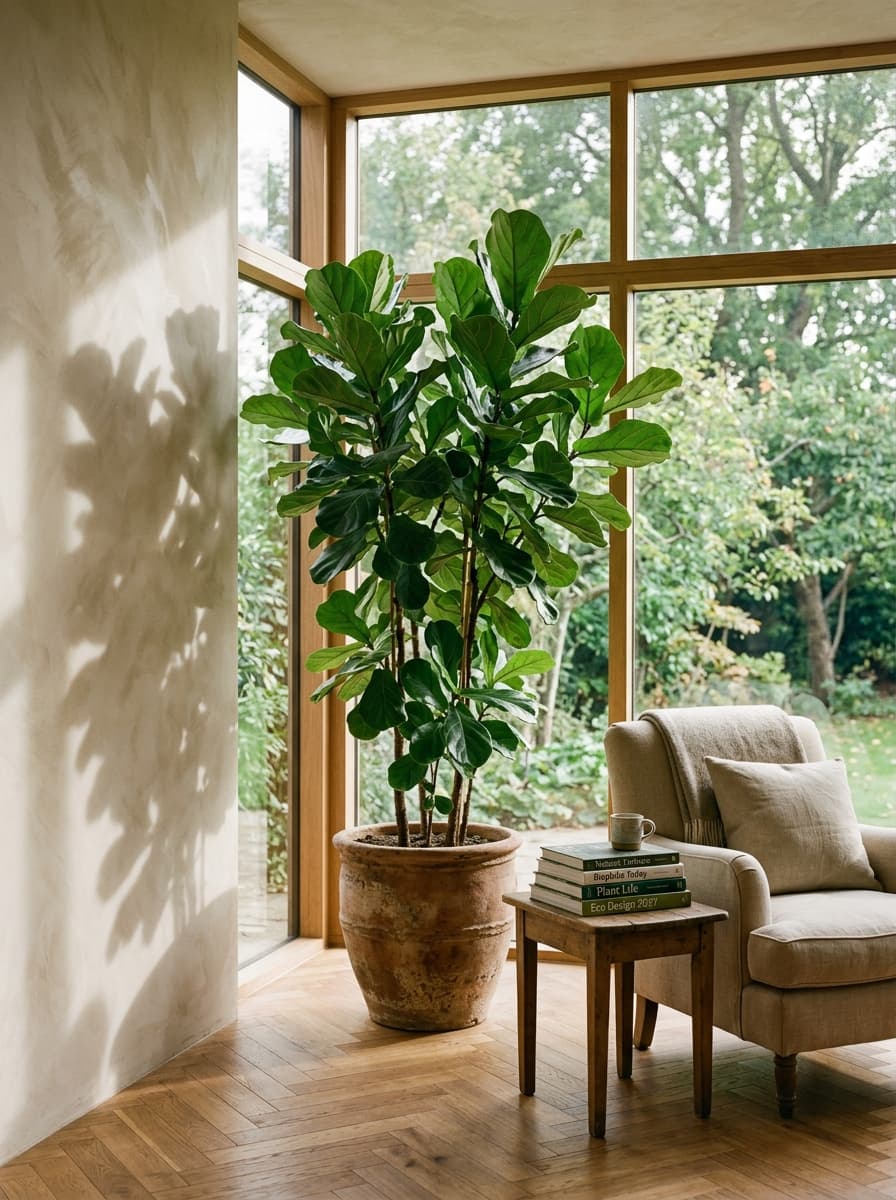
Biophilic design in 2027 is not about "putting in a fiddle-leaf fig." It is a systemic approach to building an environment that actively restores the occupant. Homes & Gardens notes that biophilic design has moved well beyond potted plants — it is now about integrating natural systems into the architecture itself. Research published on ResearchGate shows that a well-designed biophilic interior reduces stress levels by 37% and improves cognitive function by 15%.
What actually works:
- Large floor plants — living leaf shadows on walls transform a space more than expensive wallpaper
- Living walls — vertical gardens functioning as complete indoor ecosystems, not decoration
- Maximum natural light — skylights, wide-format glazing, light shafts
- Natural ventilation — layout decisions that enable air movement without relying on mechanical cooling
- Organic shadows — foliage against a limewash wall does more than expensive wallcoverings
If space and budget are limited, start with one thing: place a large plant by the window and clear everything cluttered around it.
5. Smart Home — The Age of Invisibility
The defining technology breakthrough of 2027: the smart home stopped being visible. The evolution from "look, I have voice control" to "you don't notice it, but the house already knows you." According to architectural firm Algedra, technology in 2027 is no longer viewed as an add-on — it is core infrastructure, planned at the design phase like plumbing or electrical.
Key directions:
- Predictive systems — climate and lighting adapt to occupants' biorhythms automatically, without commands
- Circadian lighting — light temperature shifts automatically through the day: 5000K at morning, 2700K in the evening, 1800K at night
- Technology as infrastructure — conduit runs, networking, and sensors are planned during rough construction, not added after
- Energy independence — solar panels, battery storage, and smart load management are becoming standard in full renovations
Renovation planning note: Run conduit for smart lighting and networking during framing and rough-in. Retrofitting is always more expensive and more disruptive.
6. Lighting: From Central Fixture to Architecture
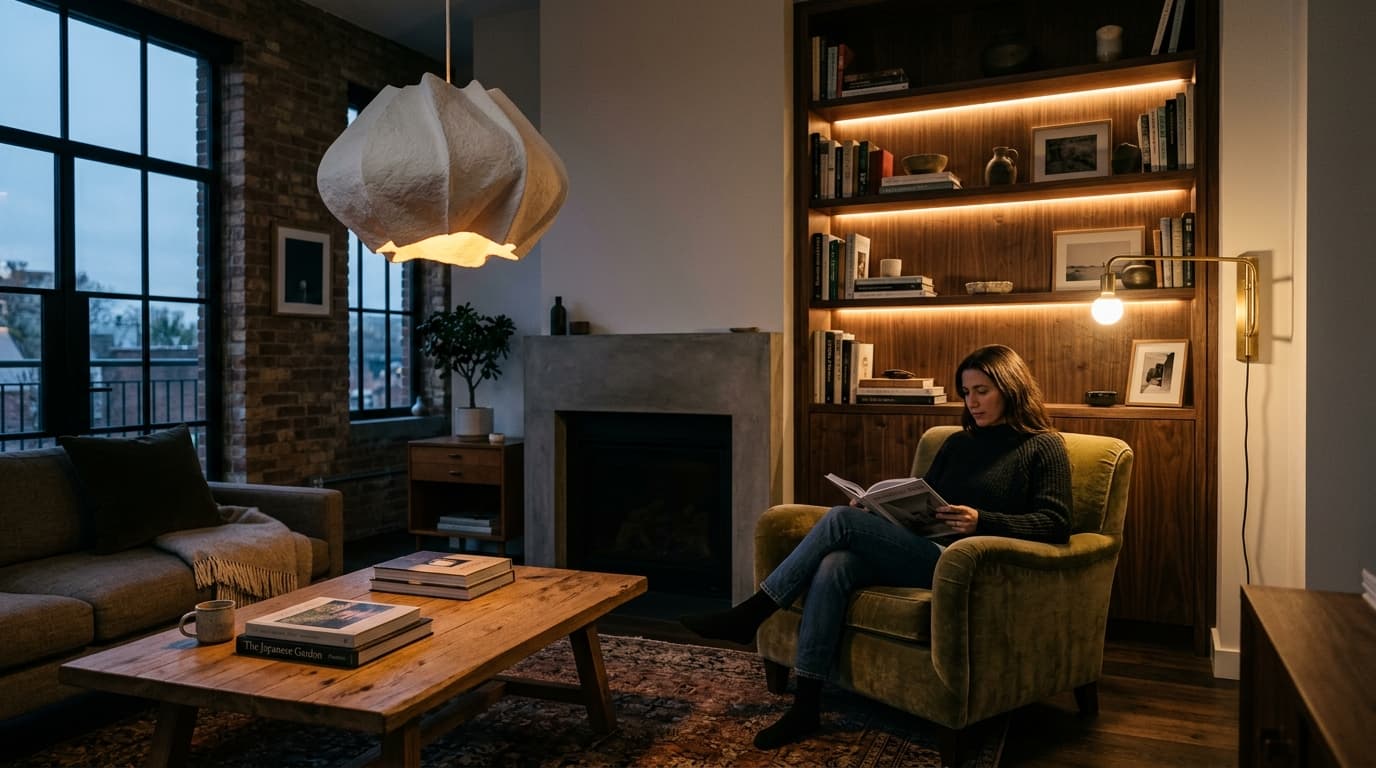
One overhead fixture is over. The modern interior is built around five lighting scenarios. According to NKBA (National Kitchen and Bath Association) 2026 research, 91% of homeowners rank lighting quality as the top factor in evaluating a space, 92% say task lighting must be included, and 80% are already implementing a dedicated nighttime scene:
| Scenario | Purpose | Source |
|---|---|---|
| Ambient | General fill light | LED coves, hidden panels |
| Task | Cooking, reading, work | Spotlights, under-cabinet strips |
| Accent | Art, architectural features | Narrow-beam directional spots |
| Atmospheric | Evening relaxation | Floor lamps, wall sconces |
| Night | Navigation without brightness | Low, warm, dim |
Technical Specifications
- Color temperature: 2700K as default, with warm-dim down to 1800K for evening relaxation
- CRI (Color Rendering Index): minimum 90 (with R9 > 50) — below this, warm earthy palettes appear flat and gray
- Mounting heights & clearances: Wall sconces mount at 55–65 inches (140–165 cm) above finished floor (AFF) at eye level. Kitchen island pendants require 30–36 inches (76–91 cm) clearance above the work surface, maintaining at least 84 inches (213 cm) headroom along general pathways
- Always test dimmers: verify driver-dimmer compatibility with the fixture at 10% load before bulk ordering
Statement Fixtures of 2027
The defining look: matte, pale, handcrafted. Plaster pendants and wall lights in chalky white read as small architectural elements, not décor. Alabaster and pleated paper are also gaining ground fast.
7. Kitchen 2027: The "Cortado" and the Polished Pantry
The Open Plan Is Losing Ground
Demolishing all walls for a single open space is losing its appeal. Remote work, acoustic comfort, and smell isolation are bringing zoning back. According to European design studios and urban remodeling reports, demand for removing all partition walls has fallen sharply, while requests for acoustic pocket doors and separated kitchens have risen. Homeowners want functional containment — and that is a completely rational shift.
The "Cortado" Aesthetic
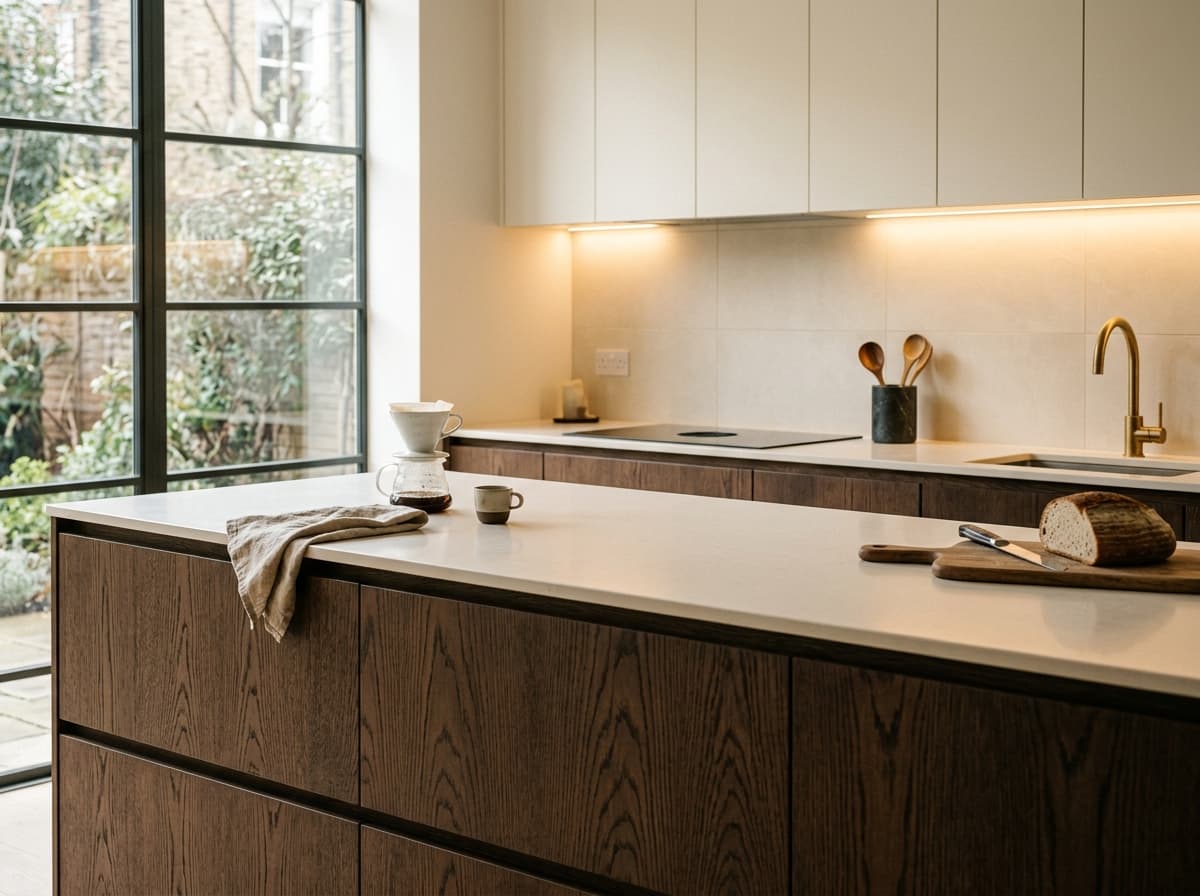
The most discussed kitchen style of the year, per Forbes:
- Base — cream and milk-white upper cabinets
- Accent — rich coffee or espresso lower cabinet faces with visible walnut or dark oak wood grain
- Countertop — seamless stone slab with no visible joints, utilizing jumbo 48–72 sq ft (4.5–6.7 sq m) slabs
- Backsplash — full-height matching stone slab or neutral limewash plaster with grease-resistant sealer
- Dimensional standards — US layouts standardly specify 36-inch (91.4 cm) counter heights and 24-inch (61 cm) depth, whereas European and Singaporean installations default to 35.4–36.2-inch (90–92 cm) worktops over 23.6-inch (60 cm) cabinet boxes
Key Kitchen Moves for 2027
- The Appliance Garage — blenders, toasters, coffee machines disappear behind closed doors. The countertop stays clear
- The Polished Pantry — the pantry becomes a display: glass doors, interior lighting, visible dry goods as a design element
- Integrated lighting — built directly into upper cabinets and under the countertop ledge
- Deep drawer systems — instead of "we need more square footage"
8. Bathroom: Your Personal Spa
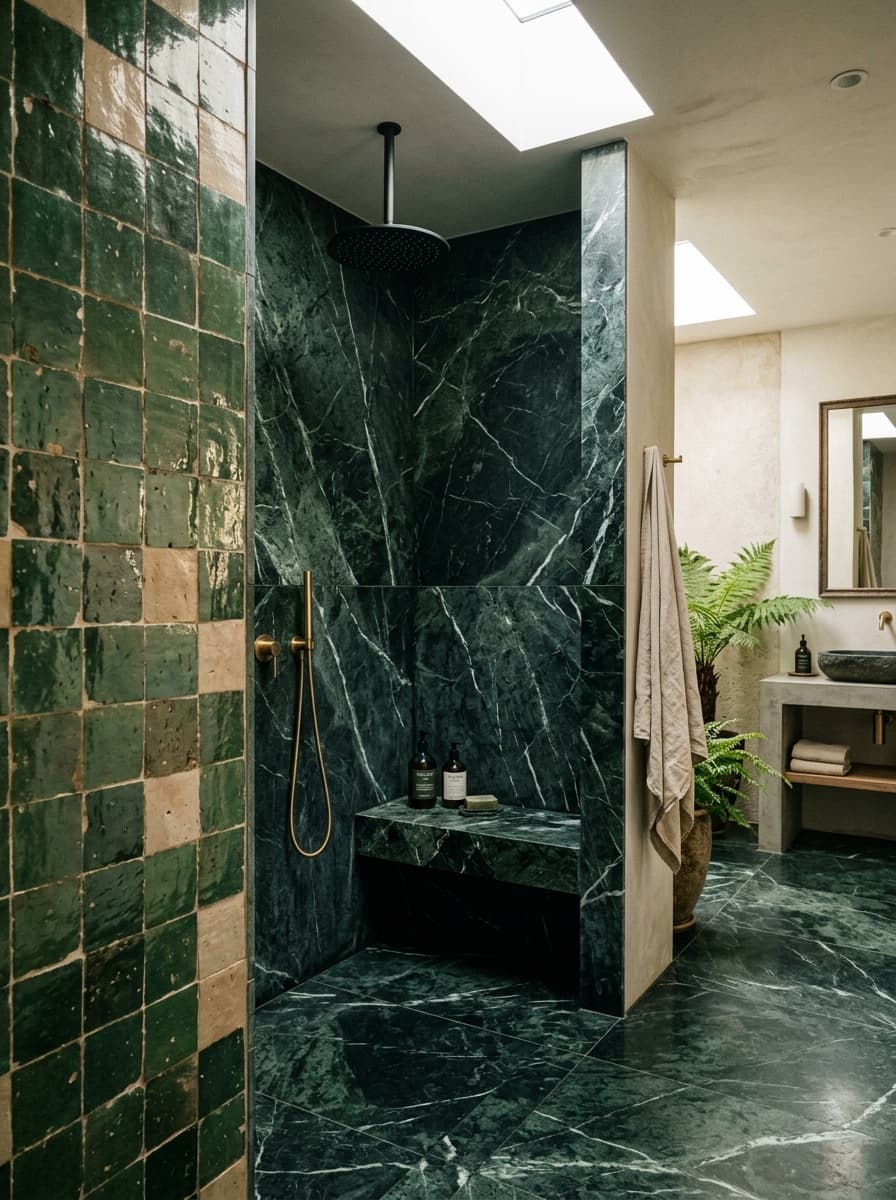
The bathroom in 2027 is not a room with plumbing. It is a place of restoration. According to Decorilla and Homes & Gardens, wellness has evolved far beyond dedicated spa rooms — the approach is now more holistic: how does each room support daily rituals, mental health, and overall comfort?
Architectural Decisions
- Curbless walk-in showers — zero-threshold flush floors mimicking boutique spa resorts. In American timber-framed construction, this requires either notching/lowering joists or installing pre-sloped foam trays with topical waterproof membranes (such as Schlüter-KERDI). In European and Singaporean masonry/concrete buildings, slopes are floated directly into floor screeds with linear stainless steel perimeter drains recessed into concrete slabs
- Built-in stone or teak floating bench — ergonomically engineered for steam sitting and body care rituals
- Ceiling-recessed rain showers with thermostatic dual-valves to prevent temperature spikes
- Recessed niches with perimeter LED warmth — eliminating clunky hanging shower racks
Materials and Tile
- Large-format porcelain slabs (48×24 inches (120×60 cm) up to 48×96 inches (120×240 cm)) — minimizing grout lines and maximizing continuous surface area
- Zellige tile — authentic Moroccan hand-glazed terracotta with organic surface variation and handmade edge imperfections for wet feature walls
- Terrazzo — returning with oversized marble aggregate and warm beige binders
- Sculptural fluted 3D tile — reserved strictly for dry accent zones behind vanities
Color Directions for the Bathroom
Two strong directions:
- Color drenching — deep forest green, midnight blue, dark slate from floor to ceiling
- Warm natural — sandstone, shell, warm sand beige
9. Furniture as Sculpture
The rule of 2027 from Bocado Lobo and Essential Home: every room needs one piece that makes the photograph. A chair with an organic silhouette. A table with a live edge. A wardrobe designed as a vertical stela.
What defines the furniture of the year:
- Rounded, asymmetric forms — a reaction to the rigidity of the digital world
- Velvet, mohair, alpaca — replacing the now-ubiquitous bouclé
- Heavy linen and tweed — for chairs and sofas
- Dark, saturated upholstery tones — warm terracotta, deep chocolate, moss green instead of cold gray
- Antiques in a modern context — an old tapestry or a grandmother's chair in a space with contemporary proportions. This is "New Heritage"
10. Analogue Spaces
In response to screen overload, a new room type is emerging — the screen-free room. Not a bedroom, but a space specifically designed for disconnection: a home library, an atelier, a games room, a meditation alcove. Veranda reports that designers are observing "a shift from a single specific style toward creating homes with greater intention" — and analogue zones are the clearest expression of that intention. According to Homes & Gardens, these spaces are the most frequently named "favorite room in the house."
What makes an analogue space:
- natural materials — solid wood, honed stone, coarse organic textiles
- soft lighting without bright focal points (2200K–2700K warm ambiance)
- no screens, no voice assistants, no digital hubs in view
- dedicated spaces for reading, tactile craftsmanship, vinyl records, or board games
This is not a luxury. A reading alcove with a linen chair by the window is enough.
What's Definitively Out: Anti-Trends 2027
| Anti-trend | Why It's Fading |
|---|---|
| All-gray-and-white sterile minimalism | Cold, corporate, emotionally draining |
| "Knock down all walls" for open plan | Severe acoustic issues, cooking odors, zero privacy |
| Bouclé on every single furniture piece | Overused Pinterest cliché from 2023–2025 |
| Plastic laminate "wood-look" slats | Ages poorly, betrays artificial sheen under daylight |
| Single central ceiling fixture | Flattens architectural volume and leaves dark corners |
| Exposed smart home gadgets | Clutters sightlines with visible technology |
| Single-showroom catalog sets | Strips the home of individual personality and provenance |
Practical Section: 2027 Renovation Checklist
1. Planning Phase
- Contingency Buffer: Establish your budget with a 15–20% cushion to accommodate logistics fluctuations and concealed site conditions.
- Priority Split: Explicitly divide scope into "essential infrastructure" (plumbing, electrical, insulation) and "aesthetic upgrades."
- Cohesive Palette: Limit each living zone to 2–3 dominant hues before purchasing finishes.
- Aging Assessment: Select materials (like unlacquered brass and oiled timber) that develop character rather than degrading over time.
- Lighting Plan: Map all multi-circuit lighting controls and wall-box depths before plasterboard installation.
2. Rough-In & Structural Phase
- Concealed Automation: Install neutral wires and extra-deep electrical back-boxes for behind-switch smart relays during wall chasing.
- Outlet Ergonomics: Place power points every 5–6 ft (1.5–2 m) along walls, including dedicated hidden receptacles inside appliance garages.
- Acoustic Dampening: Apply mineral wool insulation and decoupling clips around plumbing stacks and bedroom party walls.
- Mechanical Ventilation: Ensure adequate balanced heat-recovery ventilation (HRV/ERV) to maintain indoor air quality without open windows.
3. Finishes & Commissioning Phase
- Dimmer Compatibility: Test low-end dimming down to 10% load on LED drivers prior to closing ceiling fixtures.
- Multi-Level Ambiance: Balance ceiling, wall, and low-level task light onto separate programmable circuits.
- Hero Statement: Incorporate one sculptural focal piece (an organic occasional chair, vintage chest, or carved stone table) per room.
- Breathing Room: Leave intentional negative space — avoid overcrowding rooms with furniture on move-in day.
Room-by-Room Budget: Where to Invest, Where to Save
According to Great Day Improvements (survey of 2,800+ homeowners, 2027), 75% of homeowners plan a renovation in the next 12 months and 48% prefer to hire professionals. Large budgets (over $50,000) are becoming less common — people are spending more deliberately.
Invest Here — High Impact
Lighting (10–15% of budget) — changes the perception of any space more than expensive finishes. Warm dimmable LEDs pay off in atmosphere every single evening.
Flooring (20–25% of budget) — the foundation everything stands on. Reclaimed wood, wide-plank engineered timber, or quality stone is a decade-long investment. Quality hardwood runs $8–20/sq ft (≈$85–215/sq m) installed.
Kitchen (25–30% of budget) — the most-used room. Quality cabinet faces, countertop, and integrated appliances hold their value. A mid-range full kitchen remodel: $20,000–$40,000 (≈€18,500–€37,000 / £16,000–£32,000 / S$27,000–S$54,000).
Bathroom (15–20% of budget) — good ventilation and quality tile cost more upfront but serve 20+ years. A mid-range wellness bathroom overhaul: $10,000–$25,000 (≈€9,200–€23,000 / £8,000–£20,000 / S$13,500–S$34,000).
Save Here — Lower Risk
Decorative accessories — cushions, rugs, small objects are easy to update later.
Paint — quality matters, brand is less important than color accuracy.
Textiles — excellent alternatives to designer fabrics exist from smaller manufacturers at a fraction of the price.
FAQ: Common Questions About 2027 Trends
Should I follow all 2027 trends?
No. Choose 2–3 that align with your lifestyle and budget. Trend-chasing for its own sake quickly produces spaces that feel dated within a year. Build on timeless foundations; use trends as accents.
Is brown really replacing gray for good?
Brown dominates in 2027, but gray will not disappear entirely. The shift is toward more warmth, not the elimination of cool tones. Gray still works well in contemporary, industrial, and office contexts.
Isn't color drenching too much?
It can be, if done incorrectly. The key is varying texture and sheen — not applying the same flat paint to every surface uniformly. Start small: try it in an entryway, powder room, or walk-in closet.
Is it worth investing in sustainable materials?
Yes. Sustainability is no longer a niche preference — it is becoming a baseline expectation. Natural materials are often more durable than synthetic alternatives and age far more gracefully.
Do I need a designer for a 2027 renovation?
Not necessarily. For smaller changes — lighting, color, textiles — you can manage independently. For full renovations involving structural changes or complex engineering, a designer typically saves more than they cost by preventing expensive mistakes.
How long will 2027 trends last?
Some elements are essentially timeless: warm neutrals, natural materials, layered lighting. Others are more fleeting: specific shades, particular fixture silhouettes. Invest in the timeless layer; let the fleeting elements be your accents.
Do these trends work in small apartments?
Yes — many work even better in smaller spaces. Color drenching makes a small room feel cohesive. Warm minimalism reduces visual noise. Layered lighting creates depth. Rounded forms soften tightness.
How do I add 2027 trends on a tight budget?
Start here:
- repaint one wall in a deep, saturated tone
- replace the central overhead fixture with a floor lamp and a wall sconce
- add linen curtains and a tactile throw blanket
- bring in one large plant
- remove three redundant decorative objects
Glossary: 2027 Interior Design Terms
Analogue Spaces — rooms designed specifically for screen-free time: home libraries, ateliers, meditation rooms, game rooms.
Biophilic Design — the integration of natural systems into architecture: living walls, natural light, organic textures, natural ventilation.
Hempcrete — a bio-composite made from hemp hurd and lime binder. Excellent thermal performance, low carbon footprint, resistant to mold.
Mycelium — material grown from fungal root networks. Cultivated rather than manufactured. 100% biodegradable.
New Heritage — traditional design with its formality removed: genuine antiques placed in rooms with contemporary proportions and restraint.
Patina — the natural marks of time on metal, stone, and wood. In 2027, an aspirational aesthetic quality, not a defect.
Color Drenching — a painting technique where walls, ceiling, and trim are finished in the same hue or very close tones, creating an enveloping, immersive effect.
Circadian Lighting — smart lighting that shifts its color temperature throughout the day in step with natural sunlight, supporting sleep-wake cycles.
Layered Lighting — multiple light sources at different heights and with different purposes: ambient, task, accent, and atmospheric.
Warm Minimalism — minimalism executed with tactile natural materials. The discipline of restraint without the coldness.
Zellige — hand-glazed Moroccan terracotta tile with organic surface irregularity. Each tile is unique.
Conclusion
2027 is the year design became personal. Not trend-driven, not "same as everyone's algorithmic feed," but honest.
After decades of pursuing perfection — a turn toward authenticity. From uniformity to individuality. From disposable to durable. From digital to human.
The best interiors of the coming year will be warm, tactile, invisibly intelligent, and alive. They will carry a story — your story, not the Pinterest algorithm's.
Follow trends as a source of inspiration, not as instructions. A renovation done that way in 2027 will still look current in 2037.
Sources: Sherwin-Williams Colormix 2027 "Rewild", Homes & Gardens, Forbes, Dezeen, Bocado Lobo, Essential Home, NordicNest, Algedra, Great Day Improvements (State of American Home Renovation Report 2027), NKBA 2026 Research, Zillow Home Trends Report, Melaura, Cavmir, Veranda, ResearchGate.
Lock in colors before you buy finishes
Start with the main calculator, then use the two tools that most naturally follow this article.
This piece is grounded in current trends, room-by-room practice, and decisions that translate into real remodel work.